All I Really Want is ….Hope

[from a sermon preached at Disciples Christian Church, November 30, 2014]

Now that Thanksgiving, Black Friday, and Small Business Saturday are over, what do we 54254d98c1fb88585778239ae9f781f2have to look forward to?  There has to be more than Cyber Monday!  David and I  spent Thanksgiving weekend in the woods away from civilization,  so I don’t know the answer to this question. Maybe you can help me out …

Have we started the War on Christmas yet?

I think the War on Christmas is an absurd notion.  I found a writer who agrees with me! Diana Butler Bass says the War on Christmas folks have it all wrong.  Hearkening back to ancient Christian tradition, the Christmas season is not the entire month of December, with a pre-season that starts at Halloween. The Christmas season is Christmas Eve, Christmas Day, and the 12 Days that follow. Bass says the real war is the War on Advent! Forgotten and cast aside are the 4 weeks of Advent when Christians are called to reflect. Prepare. And wait. Wait for the celebration of Christmas when God entered our world in the Baby Jesus. It’s a War on Advent when satellite radio has been playing Jingle Bell Rock since Halloween. It’s a War on Advent when Walmart has poinsettias piled to the ceiling as doorbusters on Black Friday. But in this place of sanctuary from the war outside, we’re singing O Come O Come Emmanuel, and the only decoration is a simple wreath. A wreath with only 4 candles which we’ll light just one at a time.

Jesus wasn’t born so that human beings would spend December saying “Merry Christmas.  Jesus wasn’t born so retailers would end the year in the red. Jesus was born to change the world. Jesus was born to confront the power structures and power brokers and to introduce to them the God of peace and love and justice. Jesus was born to usher in a new kingdom where the poor and marginalized and powerless are blessed. And before his work was complete, he would die by the hands of his enemies.

But to say that is probably bad for business.

So, welcome to Disciples Christian Church where we will once more observe the counter-cultural 4 weeks of waiting. Not to worry – we don’t not wait without joy and anticipation. Our sanctuary will begin to take shape with Christmas trees and golden wreaths. This place never looks better than when it is adorned with the colors of Christmas. Not to worry, Adam will mix in a few Christmas carols amongst the Advent hymns. We’re not anti- joy and beauty of Christmas. It’s just that we need to be the one place where we will hear the message we’re not likely to hear anywhere else during December.
We begin the season by lighting a candle for hope.

allireallywanthopeIt’s a good place to begin because we crave hope at this time of year. I’m well aware that with the Christmas season comes a roller coaster ride of emotions for many people. There can be the high of falling in love again — or for the first time.  Christmas can be a very romantic season.  For others, there’s the sadness of an empty chair at the family table. Some families have already gone over their budget in buying gifts for their children.  We love indulging the kids at Christmas.   For others, there’s constant worry there won’t be enough to put food on the table. There’s the excitement of your youngest coming home from college over Christmas Break. Or maybe your son isn’t coming home because he was shot and killed at a Rec Center on the westside of Cleveland.
What part of the roller coaster are you on this year? Which way is your mood swinging?

It’s a good time to be reading from the Prophet Isaiah. Talk about a roller coaster of mood swings. Just in these 9 verses, we hear Isaiah beg and plead. He demands to see God’s face. He cries out to God wanting to know where God is.  He blames blaming God for hiding, and yet he confesses he hasn’t exactly been looking for God either.  You’ve shown yourself before God – why not now?   We call it a lament in the bible. It’s a long one – we read just a portion this morning.

I’ll stop there and ask: does anyone else care to lament a little yourself? is there anything you’d like to say to God right now?  I am lamenting, and yes, I have something to say. I’ve been lamenting much of the week. You’ve shown yourself before God. Why not now?

All is not well here, God. We need you to show yourself in a big way. All is not well when a child named Tamir Rice, who foolishly carried a toy gun that looked real to a Cleveland park on a Saturday afternoon is dead, 2 seconds after a policeman gets out of his car. All is not well when 2 innocent men spend 39 years in prison for a murder they did not commit before our criminal justice system decided to give Ricky Jackson and Wiley Bridgman back what was left of their lives. All is not well when people are taking to the streets all across our country, closing down Cleveland’s Shoreway during rush hour traffic.  Shutting down a mall because young people are staging a die-in in solidarity with Michael Brown. All is not well when Ferguson burns.

That’s my lament. Yours may be different than mine. We could argue them, but neither of us would win. Laments are not intended to be argued. Laments are emotional outbursts, and the reasoning can be faulty. Laments are protests against pain. Laments are appeals for interventions – for signs that God is listening. For a promise that God will act. Sometimes laments are personal, but Isaiah’s lament was for his people. His people who wanted God’s intervention right then.
I know the feeling. I wanted it and I wanted it now. But the reality is. Sometimes we must wait. We must wait on God, wait with God, wait for God. Waiting is always difficult but waiting is impossible without hope. Hope that the lamenting will end. Hope that there will be answers, and there can be solutions. And one day peace will come, and justice will prevail.

That’s why Isaiah’s good for us, because he had it. He said it in a word. A very simple word. Did you catch it when I read it? That moment when Isaiah’s lament turned, when he could see change ahead. The word is Yet.

All of this, God. All of it – what are we to do. What will you do? All of this seems hopeless. And yet. Yet, O Lord, you are our Father; we are the clay, and you are our potter. We are all the work of your hand. We are all your people.

Not every act of God splits open the heavens. Not every act of God shakes the earth. In Advent, sometimes it’s how silently, how silently God’s wondrous gift is given. Sometimes no ear hears his coming, but still the dear Christ enters in. God’s presence can be easy to miss if we’re not paying attention. The world did not recognize a messiah in a baby born in a stable. The world did not recognize a leader who said put your weapons down and love even your enemies. The world did not recognize the King of Kings in a barefoot man carrying his own cross.

It takes time to recognize that God at work in the world. It’s not that God isn’t there. We can be so busy lamenting we don’t notice. And yet … even during our lamenting, God has been at work in the world. It’s why we’re here this morning, isn’t it? I’m not so worried about us who are here. We’ve got our ups and downs, most certainly, but we are not people without hope.

I do worry, however, about those who are bereft of hope. Those whose lament takes the form of violence against person and property because they see no other way. Those whose voices are drowned out by others more powerful. Those who cannot break the cycle of poverty. Mothers who fear for their children when they are out of their sight. For any for whom justice may not come until their lives are over. Waiting can only be tolerated when there is hope that the wait will one day be over.

I was in a church on Tuesday night where the pastor opened the doors to provide a safe space for people to come who were grieving over the week’s events. A safe space where we could lament aloud or we could be silent, but know and trust that God was listening even in the silence. One woman spoke, saying that earlier in the day at work, when she said she 10403041_747903358591579_4844529182670141882_nwas going to church that night for this reason, a co-worker said – well, why should you care?  It’s important to the story for you to know that this woman is white.  In other words, you’re white, why should you care? She shouldn’t have had to answer but she did. Because my son is brown.

The question is not why should we care? It’s about how much. We are the people who lit a candle of hope just a few minutes ago. Is that hope burning brightly enough in us to share with those for whom the flame has flickered and died?

To close, I want to share with you a short video.  It’s a story of hope about how those of us who have it can share it with those who do not. About a man who sees hopeless and yet …. He sees what he can do. It takes place in Ferguson.

Pastor.  Parent.  Activist

Posted in Uncategorized | Tagged , , , , , , , , , , | Leave a comment

Every day matters to families in Ohio affected by gun violence …


[my remarks presented to Faith in Public Life’s Moral Movement rally on October 15, 2014 in Columbus, OH.  For a more detailed description of the legislation I mention, use this link. ]

1614023_10205178061355150_2353323349108512330_oThank you for the invitation to be part of today’s Moral Movement. We’ve traveled from Cleveland to be here representing God Before Guns, a multi-faith coalition to reduce gun violence. It’s not our first time here in Columbus, and I’m quite sure it will not be our last. The issue of ending gun violence is too important to ignore. We have cried out No More Silence and No More Names and Not One More and still we know that before the sun has set on this day that 86 people in our country will be shot and killed. Ohio is responsible for more than its share of that number, as 3 of the 86 will be shot dead in our state. Every day matters to the families of Ohio affected by gun violence.

I’m a pastor serving a congregation in Cleveland Heights, OH. When the shootings happened at Chardon High School on February 27, 2012, I spent the late afternoon with the youth of my church, including families who were there in the high school cafeteria at the time of the shooting. We cried together and talked about the horror of the day, and my eyes were opened to the reality that every child sitting  in the church’s youthroom had been on school lockdown sometime in the last year. They not only knew the drill, they have sheltered in place for real.

Just months later, I was preaching just two days after the Sandy Hook shootings in which 20 children were gunned down in less than 5 minutes. I couldn’t ignore the tragedy. Do you know the children’s book Alexander and the Terrible, Horrible, No Good, Very Bad Day?  It’s the story of a day in the life of Alexander when from the moment he wakes up things do not go his way. He trips on a skateboard. He drops his sweater into the sink while the water was running. He doesn’t get the window seat in the carpool. His teacher criticizes him for singing too loud, and there’s no dessert packed in his lunch.

That should be the stuff of a child’s life. I was preaching while other pastors were delivering eulogies for 6 year olds. How do you write one, and then how do you write 19 more? My life changed that day and no longer could I stand idly by.
Now immersed in this work with God Before Guns, I shudder as I see how guns are held as sacred. I hear The 2nd Amendment defended as being more important than the Ten Commandments, or for me as a Christian, superseding the Great Commandment to love God and my neighbor as myself. I am angry that the Ohio Legislature reinforces this. In so many ways.
There was the spring Saturday morning when I stood with parents of young children in a 10439347_10204423585255935_373974881229774368_nsmall city park in Oberlin when armed men from other parts of Ohio took over the park claiming that Ohio’s laws of pre-emption allowed them to be there, no matter what the townspeople of Oberlin wanted for their families. I was part of a conversation this morning in Mayor Jackson’s office in Cleveland where laws are being considered to keep Clevelanders safer from the gun violence that is plaguing our city – city ordinances that will be argued and fought because of pre-emption. How did these laws come to be that allow the open carrying of guns against the safety a local community wants for its citizenry?
559379_10151501397650696_640091701_nI have walked the downtown streets in a hoodie in solidarity with Trayvon Martin’s parents knowing that the Ohio Legislature will consider again this fall a Stand Your Ground law that will make it easier to justify shooting to kill. I have testified against HB231 which would grant access for guns to be taken into churches, airports, day care centers, places that previously were exempt from allowing guns. Now as the fall classes are back in session, I pray for those schools that are arming teachers, knowing that Ohio law has allowed this to happen.
Children have a right to grow up here in Ohio – the state that Slate Magazine refers to as America’s Capital of Accidental Child Shootings. I don’t like the word accidental because for a child to have access to a loaded gun, it must pass through the hands of an adult first. Ohio has no law on the books for Child Access Prevention, though more than half of states do. That needs to change. God Before Guns will be working to form alliances and buildingGBG_ImagineRespond a statewide coalition this year to make CAP a priority.
God, strengthen our resolve, bring power to our voices, and grant us the courage to use them. In your great mercy God, hear our prayer.

Rev. Kristine Eggert

Pastor.  Parent.  Activist. 

Posted in Ending Gun Violence, God Before Guns, gun safety, open carry guns | Tagged , , , , , , | Leave a comment

Willingness …

Dr-Phil-Pointing-350x231

[excerpts from sermon preached at Disciples Christian on September 28, 2014]

Dr. Phil, television’s most well-known celebrity psychologist, was once asked the question: If you could interview anyone in the world, past or present, who would it be? Dr. Phil replied without hesitation, Jesus Christ. I would really like to interview Jesus Christ. I would really like to have a conversation with him about the meaning of life.

I’ve read that Dr. Phil and his wife are devout Christians, so this makes me wonder if Dr. Phil has read this particular passage of scripture. Because in today’s passage, with an entire panel of questioners, made up of the most learned minds of the religious day – it did not go well for the interviewers. Jesus made quick work of the chief priests and elders, refusing to answer their questions by asking his own. Sitting down with Jesus as the esteemed host treating him as the interviewee – with all due respect for your interviewing skills, Dr. Phil. I’m thinking, no, you wouldn’t really want to interview Jesus because such conversations are dangerous. Your world will not be the same at the end of it. More likely your head would be spinning, and your life will be on the line.

And I love this that I read this week: You will be both confounded and claimed.

Of course the Pharisees didn’t exactly catch Jesus at the best time for a sit-down interview.Brooklyn_Museum_-_Woe_unto_You,_Scribes_and_Pharisees_(Malheur_à_vous,_scribes_et_pharisiens)_-_James_Tissot To set the context: Jesus has just ridden through Jerusalem on a donkey to the thrill of the crowds — we call it Palm Sunday –when according to Matthew’s gospel, Jesus entered the temple and became enraged when he saw the goings-on with the money-changers.  After driving them out by angrily turning over their tables, Jesus got down to the work he was called to do.  Healing.  And welcoming children. They were noisy children apparently (are there any other kind?) which further disturbed the temple leaders. So Jesus left and went to Bethany to spend the night with friends. It seem he didn’t wake up in any better mood, because on his way back into the temple in the morning when he saw a fig tree by the side of the road — a tree that didn’t have any figs on it — he cursed it.  And the tree withered to its death, right then and there.

So by the time he arrived at the temple, he was in no mood for their questions.  They had their chance to redeem themselves, and we know Jesus as our Redeemer, the paragon of forgiveness and giver of second chances. But they gave the wrong answer. They gave a very considered, careful, and political answer. As in: well, I can’t say this or I’ll anger this constituency. I can’t say the other thing because it would set off the other constituency. Maybe our own politicians learned this art from these chief priests. They cannot bring themselves to say what they really think. They cannot express what they really believe, if they even know what that is. They’re certainly hesitant to ask another question. The best they can come up with to Jesus’ question of his identity is: We don’t know.
I’d like to think that if they had given an honest answer. An answer from their hearts. Even if their answer acknowledged their doubts and fears, I think Jesus would have shown compassion to them. But in their doing the safest thing they could think of– giving no answer at all – Jesus could see that they were not really concerned about his authority, they were more concerned with hanging on to their own. Jesus rebuffed them, and it wasn’t gentle.

Remember the context. This is Tuesday of Holy Week and by the weekend, he will be dead. This is his last day in the temple. His last day to teach. His last day to issue warnings or to dispense advice. With understandably little patience for this interview in the final days of his earthly life: he puts before them the question central to his ministry: he has asked it before:
Who do you say that I am?
A life of following Jesus is not about us sitting Jesus down or parsing his words or asking him to tell us the meaning of life. To demand of him some standard of truth by which we can be convinced that he is the one. As theologian Stanley Hauerwas puts it: If one needs a standard of truth to insure that Jesus is the Messiah, then one ought to worship that standard of truth, not Jesus.

Jesus told this story:  A man had two sons. He needed their help in working the vineyard. two_sonsHe didn’t ask them to go, he told them to go. The first son refused but he later changed his mind and got to work. The second son said he would go but he didn’t. Unlike other parables, this one isn’t difficult to figure out the answer of which son did the will of his father. The first son, of course.

It may seem a simple answer, but it was a stinging indictment of the panel of questioners. These men who held such knowledge of scripture, who spoke in a religious language unintelligible to Gentiles, who lived most of their lives within the walls of the temple. These men who had said Yes to God yet cannot see Jesus (and John before him) as the embodiment of their God. Standing right there before them.

Which son were these? The ones who said Yes and then stayed right where they were. Jesus said it would have been better for you to have said No.

imagesThis is about our willingness to go to where God is. Which son are we?

We’re no longer all men in the temple, and we don’t claim to be religious authorities, but most of have been in church for a long time. Years, maybe even lifetimes. Most of us, with the exception of our younger children and newest visitors, have professed that Jesus as our Lord and Savior. We have promised to follow him.  We have said Yes, Father, I will go work in your vineyard.

And sometimes we do. This is not an across the board indictment. I’m not ready to say that we are all of us that second son. But it’s most definitely a question worthy of our consideration.  Which son are we? Putting ourselves in the position, not as interviewers of Jesus, but of those anticipating what Jesus’ questions might be to us:

  • Are you entrenched within these walls – this church where you love to be – that you’ve lost your curiosity about where else God might be at work in the world?
  • Are your eyes so focused on the screen (or at the hymnal) that you don’t see the same world that I see?
  • Would you prefer to sit me down to ask him about the meaning of life, rather than to model your lives according to mine?
  • Who would you say that I am?
  • Did you realize that when you said Yes in the waters of baptism that was not the end of your work, that was the beginning?

We are not evil people. We’re not worthless people. Neither were those men in the temple evil or worthless. They were being careful, and they were reluctant.  We are careful and reluctant too, and we have a tendency to self-limit. Those are self-limits, but are not God imposed limits. The good news is, those limits are not irreversible, everlasting, eternal or abiding.

Remember that first son. Reluctant. Not ready. Even disobedient.

Until he wasn’t. Until he was willing to not only say Yes but to get to work.

As Martin Luther once said, a faithful life is not about overcoming God’s reluctance. It is about laying hold of God’s willingness.  We are created in God’s image. And God is not reluctant – God is willing to ask us. God is not reluctant, God is willing to send the Holy Spirit to be with us in our toils. And God was not reluctant; God was willing to send us his son Jesus, the paragon of forgiveness and giver of second chances.

May God’s willingness both confound and claim us.   YES!

Pastor.  Parent.  Activist. 

Posted in Uncategorized | Leave a comment

Are you envious because I am generous …

[excerpts from a sermon preached on Sunday, September 21 at Disciples Christian Church in Cleveland Heights, OH]

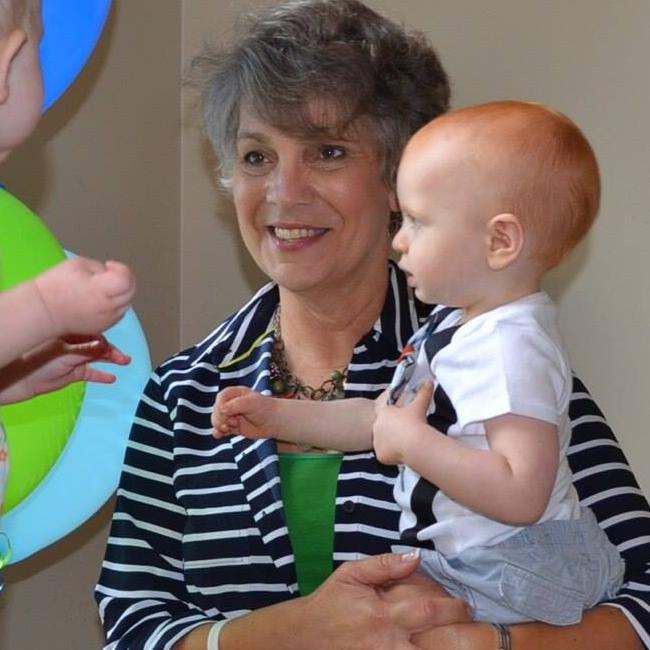
I missed being with all of you last Sunday … well, sort of. It was my birthday but that wouldn’t normally have taken me away. I’ve had a lot of birthdays and I’ve probably worked on most of them. But last year began a whole new phase of celebrating when our first grandson was born on my birthday. This year, as little Walt was turning 1 year old, his parents had an out-of-state wedding to go to, David and I were asked if we could come and stay for the whole weekend. Since we’re the only grandparents who must rely on Skype waves at a computer screen instead of grabbing a hug anytime we want to stop by, this was the stuff of which grandparents dreams are made. An entire weekend when the only stresses were would the little guy sleep all night? Would he stick to the schedule his parents so very carefully wrote out for us? Would he be glad to see us in the morning, when we were still there on the 4th morning?
But those stresses very quickly melted into what were 4 days and nights of unparalleled joy. Joy from such seemingly inconsequential moments that they seem almost too small to put into words. Smiles and giggles. Taking a step or two until falling on his bottom. Watching his little hands smashing a piece of banana, whether it was to feed it to himself or to the dog who waits patiently right next to the highchair. His small little redhead resting on my shoulder when he would get sleepy, and a big smile waiting for me when he woke up. We were only 5 hours away from real life, and yet it seemed like we were in an alternate universe.

indexThat’s where I was while you were here listening to Rev. Amy Gopp preach. And can that woman preach!  But for as skilled as she is, what makes her sermons come alive is that she has lived the gospel. She’s lived it from her hometown of Kent and in her growing up years at Camp Christian, Croatia and Bosnia, Sarajevo and Manhattan, and too many others to mention. I listened to her sermon on Tuesday when I got back, and she described the world that she has seen from her personal experience and professional position that we only wish was the alternate universe, instead of the real world.  She told us of the man whose home was on the steps of the church she served in Manhattan, and a church that needed a vote to decide if that was OK or not. She told us of women who must sell their bodies in order to feed themselves and their families. She told us of migrant workers picking tomatoes, unable to make anything close to a living wage, while we enjoy the fruits of their labor at the neighborhood Taco Bell.

After hearing all that, I was tempted to get in my car and drive back to where life seemed ideal.  But that not being an option, I did what I do every week — I dug into the text for the next sermon. Jesus is teaching us by parable this week. You know about parables? Those stories where the leading roles are played by people just like us, where circumstances happen just like they do in our own lives. Parables are always about how the world ought parablesto be and how people ought to behave in order for God’s desire for how the world is supposed to be. They end with a moral imperative, of course, but before that, there’s always an unexpected twist that turns what we think we know upside down. A twist that makes us realize how wide is the chasm between how things are and how they would need to be for God’s vision for the world to be the reality.

Parables describe God’s kingdom here and now that we’re supposed to be at work building. Building, not trying to escape the parts we don’t like as I did last weekend. And not by accepting the injustices as Amy described last week. But by living in it according to what Jesus taught. That’s what parables are about. What parables are not is making us feel good about everything or to tell us that our work here is done.

Because, boy oh boy, when we read today’s story of the Vineyard workers, do we see that there is work to be done! This story hits us all.  Anyone with a strong work ethic. Anyone who has shown up every day on time to punch the clock and stayed until the work was done. Anyone who must travel far to where the jobs are.  For union guys.  Feminists who demand equal pay for equal work.  For any manager who answers to a boss whose eyes are on the bottom line. Shareholders who vote. Bankers who loan. Investors whose job it is to maximize portfolios.  To anyone of the above, this story just doesn’t make sense. There’s no metric by which we measure success that makes this good business practice. To pay people the same amount for fewer hours of work.
imagesAnd if we’re brutally honest here, especially to pay people the same for fewer hours of work when they are those people. Those people who show up late or unprepared. Unskilled, uneducated, maybe even undocumented. Those people who don’t want to work. We might say under our breath: They’ll take whatever they can, as long as someone’s willing to give it to them. That’s how we picture day laborers or those who stand on street corners, isn’t it? We live in a world of those givers and takers, to listen to our politicians.

This story does not bring out the best in us.

In a parable, God is always one of the players. And so by now we’ve figured out that it is the landowner this time who is God. Because no one else would describe such a workplace. No one believes in the worth of every person. Even in those who aren’t chosen first or chosen at all. There is humiliation in not being chosen. I can still remember back to 5th grade, not being chosen for a kickball team. No one who wanted to win would have chosen me first or until there were no better choices available. But this isn’t fifth grade; this is serious as anyone who is without a job in today’s tight job market will tell you. Whether you’re too old or the wrong color or gender or someone would work cheaper, or whatever else can be decided by an unfair whim. Judgments that we make about who is left standing and unchosen at 5:00 in the afternoon are most often mistaken and unfounded. This landowner who we’ve now figured out is God believes in those left standing at 5:00 so much so that God gives to them all that God has promised to us, and we don’t know whatusthem to do with that. Mostly we don’t like it because …

You’re making them equal to us.
And God says, Yes. Exactly. High five. Fist bump. Now you see what I mean. You get it. Now we can get started on building that world. Won’t take long now that we’re all on the same page.

And we answer:  Hold on, God, wait just a minute. We’re not there yet. Not sure we have the same measure of generosity that you do, God. At least not until we’re sure that we have enough of what we need, be it wages or respect or fairness or assurance of our own security or to cash in on the privileges we’ve work so hard for.

To which God replies:  are you envious because I’m generous?

Don’t you hate it when God cuts through all our words and comes quickly to the point? Don’t you dislike it when God so efficiently separates out what it is we think we need and instead gives us what is enough? Isn’t it maddening when God so pointedly puts us in our place, when it’s not at all the place we think we’ve earned, separating us from them. Doesn’t it frustrate and confuse us when we hear these stories that remind us that God will always choose the side of the weak, when we live in a world in which the strong can crush the weak, and we have to survive somehow.
We are envious, to be sure. But we are also in need of convincing that we too are worthy of God’s generosity. For many of us, that will take our entire lifetimes. It’s why we worry that we won’t have enough. It’s at the root of our fears, that we won’t be kept safe, included, forgiven, and loved. We’re not convinced that God has our back while also making the way safe for us to travel. Maybe we don’t really believe that it’s also there for us. But as the poem on the front of your bulletins will remind you this week, the sun shines on every face and each day ends with grace.

We are made in God’s image, and today’s image is one of generosity. It’s in our DNA, and if as followers of Jesus, we could claim that and own it, there wouldn’t be such a wide chasm between the world these parables describe and the world in which we live.
group-hugIn that world, a shepherd could leave behind 99 sheep to go after just 1 that lost his way and not lose his job. That woman could take the time to turn her house upside down for just one small coin, and we wouldn’t think it a waste of valuable time. That father whose adult son has utterly disgraced him could not only welcome him home but would break into a run in order to throw his arms around him, when no dignified man of his day would run unless chased. Instead of a world in which we spend time debating what constitutes abuse in father-son relationships, not for adult sons who have squandered fortunes, but for 4 year olds riding in the back seat of a car.

What world is Jesus describing? The world God desperately wants us to be a part of. The world God desires. The world God is expecting us to build. A world in which everyone has enough and everyone has a place and everyone is given the privilege of serving.

We spend far too much of our energy hoping and even claiming that God is on our side. When, as Abraham Lincoln once said, our greatest concern needs to be that we are on God’s side. And on God’s side, generosity isn’t something to be understood or accounted for, calculated, quantified, or begrudged of the one who receives it.

Because that someone is you. And that man sleeping on the steps of Park Avenue Christian Church. That someone is me and my grandson safe and snuggled. And that someone is a child racing to cross our border to escape the horrors of her homeland.
Who needs to be first in line when we will all receive a full measure of God’s generosity?

Pastor.  Parent.  Activist
Posted in Uncategorized | Leave a comment

Living Large? No, not this time …

I’ve returned to my on-going work as a pastor of a local congregation after an extended weekend away.  This week I have a sermon to research, pray on, write, and deliver.  I have pastoral calls to make.  Administrative stuff to decide.  Tasks to delegate.  In many ways my job is no different from any other.  But for us who are pastors, there is also the matter of the gospel and how it is Jesus expects us to live.  It’s a large message, and pastors can get caught up in the largeness and the importance of the work we do.

I also took a break over the weekend from a role I take quite seriously.  Activist.  Specifically to the issue of ending gun violence.  Over my 4 day break, close to 350 people probably died in our country from a gunshot wound and nearly 10% of those were likely children.  The two sides on the issue didn’t come any closer to agreement, and I”m sure the verbal sparring continued on social media.   It’s a large issue with large life and death consequences.

But there are 3 prongs of identity to my signature.  I’m also a parent And it was that role that took me away from the other 2.  David and I were asked to be full-time grandparents as our daughter and son-in-law had a wedding to attend out of state.  It also happened to be a birthday weekend — mine and my grandson’s first.   To offer some context, David and I are two of 8 grandparents, as all of us have been married, divorced, and married again.  We are one of those blended families you either read about or are part of yourself.  We are the only 2 who live out of town.  The only ones who see this little boy’s antics mostly on Skype.  To be offered the opportunity of a weekend is the stuff of our dreams!

10614131_10204911416489195_1956740318659142870_nSo, important pastor’s work was covered ably by others.  Activist’s work was put on hold.  And our weekend became the stuff of little things.  Would the little guy sleep all night?  Would he be glad to see us in the morning?  Would he stick to the schedule his parents’ expected us to keep?  Those were our only stressors.  But oh so quickly any stresses, large or small, morphed into an alternate state of being for me.

Celebrating the small, seemingly inconsequential, moments of the day.  A smile and a giggle.  A hesitant step before falling on his bottom.  Watching the pleasurable sensations of mashing a banana whether to feed it to yourself or to offer it to the dog patiently waiting next to the highchair.  His small little redhead resting on my shoulder signaling time for a nap, grandma.  His trust that we were enough.  In that sleepy moment and when he would wake up.  What we had to give was what he needed.  And what he gave to us, the same.

And so much more.

Henri Nouwen once wrote:  Because life is very small, you can never see it happening.  Have you ever seen a tree actually grow?  Can you see a child grow?  Growth is too gentle, too tender.  Life is basically hidden.  It is small and begs for constant care and protection.  If you are committed to always saying yes to life, you are going to have to become a person who chooses it when it is hidden. 

I did see a child grow last weekend because I was focused on small moments.  I don’t know 10171234_10204865655985211_2252856148164830271_nwhat my grandson saw.  He’s not a writer, nor does he speak so we know what he means.  Not yet.  But I hope he saw me grow, as he taught me the value of small. Did he know that in his small and gentle ways, he had the power to bring me back to life?  He did.

So, I’m  back to what I do and what I believe I am called to do.   Will I change the world today?  I hope I”ll make a difference to someone.  Will I grow because I’ve witnessed life giving moments however small?  I pray so.

Pastor.  Parent.  Activist. 

Posted in Activism, Ending Gun Violence, Grandparents, Moms Demand Action, Uncategorized | 2 Comments

A picture is worth a thousand words …

The phrase is said to have originated in 1911 and was made in reference to a newspaper article about journalism.  Much has changed in the journalism world since 1911, but the adage still rings true. 

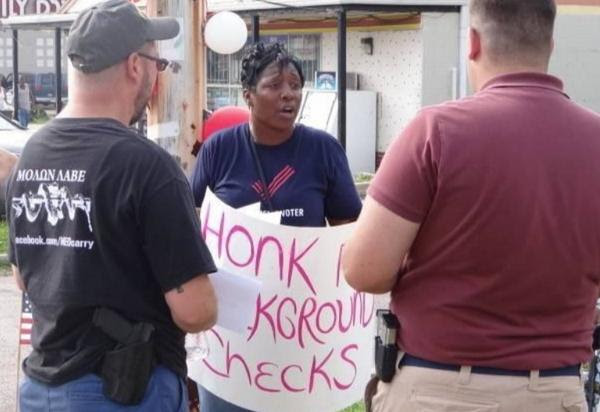
This photo was taken in Akron, OH on a recent Saturday.  Though I was not the photographer, I was standing just feet away10660281_358918424261718_3141767135922155845_n from him when this was taken.  The occasion was a Rally for Ending Gun Violence.  It was open to any and all who are concerned about the rising tide of gun violence on urban streets.  It was intended to be peaceful.  The rally was promoted on social media and so the open carry guys in our state decided they needed to pay us a visit.  In their words, they needed to “educate us” about guns.  They were armed, and these are not the only two.  The woman in the photo became an activist after losing someone close to her in a domestic violence shooting.  She’s holding what most would consider a pretty benign sign.  What reasonable person can possibly object to background checks? (Yes, that is said through clenched teeth!)
24 hours later, this photo had been posted on Facebook and on Twitter.   Twitter limits you to 140 characters per Tweet, so there were not thousands of words, but there were thousands of re-tweets of the photo.  It was picked up by several on-line news sites, like RawStory and on the other side of the argument, Guns.com. I’m fairly new to Twitter and it was the closest I’ve come to going viral.  A few examples of the tweets:

that is one brave lady talking to those armed white man

open carry strangers.  she lost someone to guns.  Two cowards and one strong woman.

they should remove their guns out of respect

open carry is all about intimidation.  racist in practice.  unequal in toleration

they are not looking to have dialogue.  they are trying to intimidate her. 

Go away.  Leave your guns at home.  Then come back like civilized human beings.

She’s armed with courage.  They’re armed with — well you can see their approach to persuasion.

Woman in her neighborhood with common sense sign.  These guys crash her rally.  Very definition of #gunbullies. 

10614255_358917770928450_617690280631979066_n(1)There were plenty of tweets from the open carry guys, but I won’t give them the attention by posting any of them here, and besides the language is offensive in most.  Ending gun violence activists seem to bring that out in them. I get so angry sometimes that I’m tempted to snap back in the same vein.  I remind myself often that I”m a pastor.   I’ve said before in other blog entries that I refuse to be intimidated or scared away from events where people are carrying guns.  It’s part of my pact with God (I pray!) that I will be kept safe.  But loaded weapons carried casually in public settings like this ARE dangerous, and I will do all I can to work to change minds, hearts, and laws for a safer time in our country. 

This photo was taken during a conversation this open carry demonstrator initiated with me about the 9 year old girl whounnamed2 was allowed to fire an Uzi at Burgers and Bullets near Las Vegas just a few days earlier.  When she could not control the weapon (understandable), the gun instructor was killed.  Mr. “Keep Calm and Carry Guns” was explaining to me all the ways the instructor was at fault.  You can see all the things he did wrong in the video, he said.  I was incredulous.  So, you think it’s OK for 9 year olds to shoot Uzis?  I didn’t have to hear his answer to know what it was.

How sad.  How sad on so many levels.  This man.  The owner of Burgers and Bullets.  Countless others.  They cannot even grieve the death of one of their own.  First and foremost, they must bolster their argument that the answer is always more guns.  Freer accessibility to guns.  Introducing guns to the youngest of children.  They will not be told how to safely store their guns.  They will not be denied their interpretation of 2nd Amendment rights to carry openly whenever and wherever they feel like it.  They will try to intimidate our use of the 1st Amendment by showing up armed.

Is human life of less value than a gun?

So, here’s the photo again.  Write your own caption.  Mine would be something like:  There cannot be open conversationunnamed as long as someone is armed. If you want to talk, leave the guns at home. 

That’s just common sense, yes?


Pastor.  Parent.  Activist.


Posted in Activism, Ending Gun Violence, God Before Guns, gun safety, Moms Demand Action, open carry guns, Racism | 1 Comment

Work Issues …

[Excerpts from sermon preached Labor Day weekend 2014 at Disciples Christian Church in Cleveland Heights, OH].

jannette050-900On any given work day, Jannette Navarro, a 22 year old Starbucks barista and single mom, tries to put the pieces together for another last minute plan. We know about Janette’s work issues through a recent interview for the NY Times. At the time of the interview she was working on a plan for surviving the month of July without setting off a financial disaster – or a family crisis.

That said, Janette was grateful to have been hired as a barista at Starbucks for $9 per hour. She got the job largely due to her persistence. She just kept showing up. Always cheerful. Asking for work.  The barista job was definitely a step up from working at the Dollar Tree and KFC, her two most recent jobs that she held simultaneously.

Before that she was on public assistance, and determined never to go back on, she was justjannette046-1254 a few credits shy of an associate degree in business. Listening to the other baristas talking about getting their masters’ degrees, Ms. Navarro began to think about that possibility for herself. But her take-home pay was rarely above $400 every two weeks. If she got to $500, it was a celebration. Even so, since starting in November, she had managed to set aside $900 toward a car – her next step toward stability and independence for herself and her 4year old son, Gavin.

But if she could change one thing about her job, it was the issue of her fluctuating hours. She felt like she was in constant clock crisis. She rarely knew her schedule more than three days before the start of a workweek. Which made it next to impossible to figure out child care. She’d been living with family who helped out with her son, but they had jobs too – some of them with unpredictable hours. She couldn’t cut back on her hours. Sometimes she needed the dimes from the tip jar to make the bus fare home. She didn’t want to rock the boat by asking for more stable hours.

Starbucks is one of an increasing number of corporations who are using a scheduling software program called Kronos. The software developer says, It’s like magic. Helping large corporations like Starbucks choreograph their workers hours. It’s a choreography that boosts profits and cuts labor costs with just a few keystrokes. It’s good for the bottom line, and it’s good for managers who are compensated on the efficiency of their staffing, but the effects on employees can be devastating. In Ms. Navarro’s case, even the amount of sleep her son Gavin would get was controlled by her job. On July 4 weekend, she worked until 11 pm on Friday. She reported in again on Saturday at 4 am. And Sunday morning, she reported for work at 5 am.

In Starbucks defense – I know there are a lot of Starbucks fans out there – they are not the worst employer out there. Sometimes, they argue, variable hours can be a plus. They point out that they provide benefits like health care, 401K with matching contributions, and tuition for online degrees.  Many retailers fall far short of this. But not all is as it seems. Ms. Navarro said she was just 3 classes shy of being able to transfer her credits to take advantage of the tuition offer when she had to drop out because of her unpredictable work schedule.  I should mention that since this article appeared in the NY Times and on NPR and in other news outlets, Starbucks has agreed to look into the issue across the board in their stores.

Work issues. Who doesn’t have work issues?

Thursday was a day when I saw lots of my church folks.  People who were in the building during the day, lunch with a church member, a hospital visit, the volunteers in the kitchen for the community meal, Connections band rehearsal, and a meeting in my office on Thursday evening. I wasn’t consciously conducting a survey about people’s work issues, but I sure got an earful about them. One was worried about his job being cut. Through no fault of his own, there just aren’t enough clients to serve. Another is responsible for the care of her parents, exhausted from going to the hospital right after work, staying until bedtime, getting up and doing it all over again the next day. I just can’t take any more time off. I’ll lose my job. Another who is working two jobs said I haven’t seen my family in three days, I’m up and out the door before they even wake up, and they’re in bed when I come home.  Another said, doing home daycare is exhausting at my age.   My new position is OK for now, said another, hinting that she’s probably looking for the next job.  A career teacher said, I’d do anything else.  Anything.  And it’s just the first two weeks of classes.

Work issues. The only time you don’t have work issues is if you’re not working. Except if your not working is not by choice and you need and want to have a job. I had those conversations here at church this week too.
The conversations weren’t all negative. There were at least a couple of people who were content in their work. I’m super busy this time of year. But it’s a good kind of busy. Working in his field of study. Paid well enough. I wouldn’t want to leave. And of course in this church – and in any church – there are some who choose to not work outside the home, and many who have already built their careers and are retired.  You might think they are exempt, but I want to make the case that all of us are subject to work issues.

I’ll use Moses as my example.  [Special thanks to the United Church of Christ worship resources for connecting Moses and Labor Day 2014]

shepherd-sheepAt this stage in his career in Exodus Chapter 3, Moses was working as a shepherd. Shepherd was not a job one aspired to. It was dirty work with lousy hours, and I’m not sure it even qualified as a low rung on the ladder to success. That said, Moses may have felt fortunate to have even that job. He was an immigrant for one thing – having fled his own country. He was a job market pariah – equivalent to a convicted felon in today’s job market – he fled because he murdered someone. But things were looking up for him. He found a new life. He got married and was a father. And his father-in-law got him a job this shepherd’s job. Maybe things weren’t so bad after all. Things were going well enough that maybe he’d forgotten the life he’d left behind. Maybe he’d forgotten the people he left behind. He wasn’t concerning himself with the oppression the Israelites were suffering.

Moses might have forgotten, but God had not. Forgotten. And God has some powerful ways to make sure that we don’t forget either. God got Moses attention in a big way – God’s voice coming from a burning bush that refused to burn itself up, right there in front of him. It wasn’t enough for God that Moses was OK with his job. God knew he could make a difference in the lives of others. So God called him out to do something more than just take care of himself.

When I began preaching Labor Day sermons about 20 years ago, it seemed very different. I most often preached about call and vocation. I’d quote Frederick Buechner who said: The place God calls you is the place where your deep gladness and the world’s deep hunger meet. I’d preach about finding the place where your gifts and talents match with the needs of the world.  And somewhere along the way, I realized that there are few people – and fewer all the time – who have the privilege of finding that place and being paid to work there. Not because they don’t want to. But because they don’t have the resources or the time or the opportunities to do anything other than what they’re already doing. I realize now that there is a vocation privilege for some like myself, but for many more others, they see very little of God in their work week.
[Vocation]

I don’t want to give up on call and vocation, but we need to re-think them.  God hasn’t given up on them. God hasn’t given up on opportunity for all. God hasn’t given up on those who haven’t had the privilege of finding it. God still calls us. God calls us to be looking out for and taking care of each other. That call may come in the life-changing, awesome moment of a burning bush – though probably it will not. More likely, God’s call will be more a nudge, or butterflies in your stomach, or a persistent tap on the shoulder.  Maybe a quiet whisper that says:  maybe we ought to be doing something about a particular issue. Current issues are more than the stars. Today we’ll limit the conversation to issues of the workplace and the marketplace – for they are related.

God is calling us to do something about the inequities and the injustices, the disrespect and disloyalty. Even if we like our job well enough. Even if as a manager or a business owner the bottom line is looking good. Even if our working years are behind us. Work issues are still our responsibility.  Like they were for Moses (with a not-so-gentle nudge from God).

The Apostle Paul also has something to say to us about involvement.  Don’t be fooled byworker the word hospitality – this is about more than coffee and donuts. Paul lived in an unjust world as do we, and in such a world with million living below the poverty line, genuine love demands our involvement. Loving our neighbors can mean standing with people who do not make a living wage, who must rely on SNAP benefits workers3even though they are working full time. Being ardent in spirit can mean using our energy and resources to fight for things like family leave and sick time. Showing honor is about treating people well – the people who work for you, people who serve you, wait on you, who count on tips to survive. Persevering in prayer can mean taking that conversation you have with God a step further by paying it forward for someone who’s too tired and discouraged at the end of a work day to have much to say to God.

A preacher friend of mine said recently that moving from the story of creation in Genesis and the beginning of the story of the people of God seems to come to an abrupt halt when we start to read Exodus.   That the subscript to Exodus could be: now everything gets worse.  It seemed that way on Thursday for many I talked with. When the job we have isn’t what we want. Or the job we want won’t have us. Is it that person’s issue – or is it an issue we share together?

Remember that Moses made it his issue, even though he had escaped and found better work.  Moses didn’t ignore God’s call. He didn’t shrug it off a tap on the shoulder only to go back to watching the sheep graze.  And it took awhile, but he rescued those people, and to say their work situation improved, would be putting it mildly!

Our work situations vary here at Disciples from those too young to work and those long since retired, to everyone in-between – one thing we share. We are all called by God. Not one of us is uncalled. An uncalled life assumes an autonomous existence in which we have no one either to help us when we struggle or to leave us alone when we’re doing just fine thank you. An uncalled life is one in which no one calls us out by name or cares that we’re there. But that wasn’t the shepherd named Moses. It wasn’t what Paul preached. And it wasn’t how Jesus taught, lived, or died. And it’s most certainly not us.

And what God calls us to is to make the world a more humane, just, and loving place in which to work and live.

Pastor.  Parent.  Activist. 

Posted in Activism, Labor Day, Uncategorized, Work Issues | Tagged , , | Leave a comment

#HandsUpDontShoot …

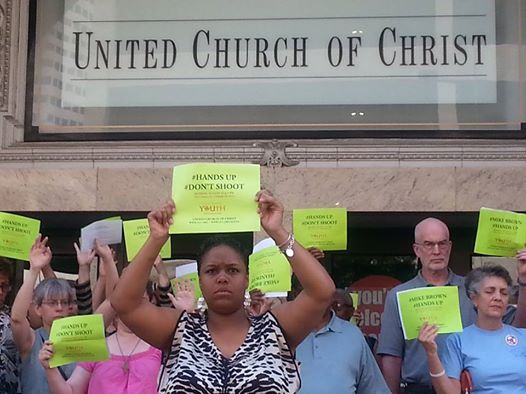
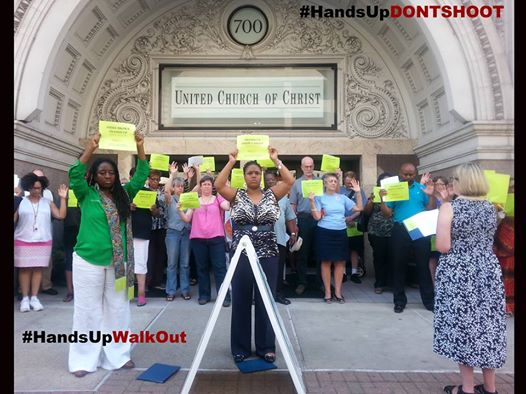
1620863_10204732715941793_5072614269326404509_nYesterday I participated in a Vigil of Solidarity with Ferguson, MO at the United Church of Christ Headquarters in downtown Cleveland.  Late on Sunday afternoon, the flyer was posted on Facebook saying:  All are welcome to share in this peaceful assembly.  So, together with 4 others from the Disciples of Christ church that I serve, we went.  We began with prayer, proclamation, and song inside in Amistad Chapel.  The Chapel appropriately enough was dedicated in 2000 in honor and memory of memory of the African captives who revolted aboard the ship Amistad in 1839. The last time I was there it was to begin a silent walk through downtown streets in solidarity with Trayvon Martin’s family, and we were dressed in hoodies.

We followed the lead of the Rev. Dr. Courtney Clayton-Jenkins to stand outside on this10649999_845746205436186_4819788049837062723_n day.  Rev. Jenkins called out from the Psalms:  Rise up O Lord: God, lift up your hand.  And we answered:  Hands Up.  Don’t Shoot.  Again and again, over and over with our hands raised until our arms tired from the position.  We read in call and response words like:  we pray for the families of children who have been slain by gun violence, left to die on streets with less dignity than is given to animals.  Then we were silent.  It seemed a long while.  Hands raised.  I alternated between keeping my eyes closed in prayer and having them fully open staring straight ahead.  I was holding my hands up symbolically.  I wondered what it must be like to be in that position with your life on the line.  My tears flowed.  To be honest, I can wonder all I want, but most likely I will not know because …

I am white.

I began this work to end gun violence on Sunday, December 16, 2012.  It was just two days after the Sandy Hook shootings.  I preached a very different sermon than the one I planned.  The killings of first graders demanded it.  I began with an illustration from a children’s book, Alexander and the Terrible, Horrible, No Good, Very Bad Day.  Alexander drops his sweater in the sink.  He doesn’t get the prize in the cereal box.  His brother gets the seat by the window.  His lunch is missing a dessert.  That’s the kind of day a child should call horrible, I preached.  Our children are just a gunshot away from a very different sort of very bad day now.  Few days have passed since then that I have not been actively engaged somehow to end gun violence as we know it now.

1407876745000-GTY-453497542-66427208Ferguson feels different, and what I”m feeling is taking me many layers more deeply into my activism.  I’m not equipped to write about it.  Others can do that far better and with more integrity than I.  Just this morning and as just one example, columnist Charles Blow said it well in the NY Times.  Read it. Comment on this blog and lead me to more that is helping you to make your way through this.

At the dedication of Amistad Chapel nearly 15 years ago, someone prayed that the portrait of Amistad leader Sengbe Pieh would gaze upon us, disturbing comfortable accommodations, inspiring courageous action.

I pray the same and promise to be open to where next God will lead me.

Pastor.  Parent.  Activist. 

10517483_10152213379861787_2794548650100714487_n


Posted in Activism, Christian, Ending Gun Violence, Ferguson, God Before Guns, Uncategorized | Leave a comment

Getting ahead of ourselves …

[Excerpts from a sermon preached at Disciples Christian Church on Sunday, August 17, 2014]

Summer is the season that church people ease up, but based on the scriptures we’ve read the past few weeks; our summer slowdown comes during Jesus’ busiest season! Jesus is out there working miracles like the feeding of the 5,000 and walking on water to rescue the disciples. There are no dramatic miracles this week. This week, we see Jesus as a man. Perhaps more human than we’d like and more human than we know how to deal with. Jesus is caught with his compassion down, and it’s not a pretty picture.Jesus-Resisting-the-Canaanite-Woman-from-Icon-Visual-Images-for-Every-Sunday-Augsburg-Press-293x300

This is always a tough story. It’s difficult to talk about this story without making Jesus sound at best insensitive, and at worst — a jerk –in his treatment of this poor woman. There are ways to try to soften it. Bible scholars tell us the translation from the Hebrew doesn’t mean dog exactly — as in a scavenger dog scrounging for food on the streets — it means puppy. That doesn’t make me feel any better about Jesus’ reaction. You?

Or, the argument is made that Jesus intended to help her all along. He was in on it.  He was just testing the disciples. But, why would Jesus put her through that?  Matthew left behind this story for us to deal with, warts and all. So, here goes with my take …

Jesus ignored her.  I think this is the first time we’ve seen him ignore anyone.  He allowed himself to be drawn in by the disciples – those same guys who were often irritated by people trying to get close to them.  Their work was so much easier without people crowding around!  And when Jesus does get around to speaking to her, …rude doesn’t begin to describe the name-calling.  Remember Jesus was on her turf.  He was in her country, among her people.  If it had been anyone else but Jesus, we’d say he was prejudiced against her.

That Jesus could be prejudiced shocks us, but the story ends with an even bigger surprise. The story ends with Jesus changing his mind. He went from being dismissive to being persuaded. Persuaded that he was wrong in his first response. Persuaded that she was someone to listen to. We might say he flip-flopped. Oh, the press would have jumped on that! We don’t react well to a leader who changes his mind. People want a leader who believes he’s always right, ready to take control of the situation, decide on a course of action. What are we to do with a leader who is at the mercy of others? Especially an other who is of seemingly little importance like this Canaanite woman?

But let’s not get ahead of ourselves here because if we spend all our time talking about why Jesus did what he did, there won’t be time to talk about the very person he ignored. And she’s far too important to ignore.

Let’s not get ahead of ourselves. You know that expression. We use it to describe how we assume that something will happen before it’s absolutely certain. We’d be getting ahead of ourselves if we bought a wedding dress and sent out invitations before there was a proposal. We’d be getting ahead of ourselves if we started high-fiving and fist-bumping before we’ve actually won the game. We put don’t at the beginning of the phrase as a warning. Don’t count on something that may not happen.

I’m using it in a different way this morning. There’s no don’t, and rather than it being about something that may not happen, this is about what’s already real. It’s just that we’re not ready for it yet. Getting ahead of ourselves is living into a reality that we’re not ready for.

We have Jesus as our example. Jesus wasn’t ready for the reality that this foreigner was as much a child of God as any of his disciples. Jesus wasn’t ready for the reality that a woman was deserving of his time and as deserving of his mercy as anyone else. He wasn’t doing anything wrong according to what was acceptable in his culture. She was a woman and a Gentile. He was allowed to ignore her or to call her anything he wanted. Maybe one day, Jesus would have been ready to realize that his mission included her. But he wasn’t ready that day.

He wasn’t ready. She was.

And so, she challenged him. She used his metaphor about a dog and one-upped him. She questioned his attitude. And convinced him that something larger was at stake. Her humanity. Jesus says it was her great faith that convinced him. As for what that great faith looked like – all we can see is that she manages to hold to what she believes is right. She talks back to his power.  She answers his prejudice. For her daughter. We mustn’t ignore her daughter either.

What does Jesus change of heart and change of mind say to us?  Last week I suggested that you name the knots in your stomach. This week I suggest that you name who it is you are not ready for.  Name who is your Canaanite woman.  

I’ll name two possibilities.

Last night was the Closing Ceremonies for the Gay Games that were hosted here in Cleveland. 10,000 LGBT athletes from-16339951183e74ef all over the world were here to compete, and thousands of supportive friends and families were here for the fun. It was a great time and a week-long party. Disciples Christian Church was a community sponsor of the games, and several of us participated in a variety of ways.

The support for being a community sponsor came with a broad swath of support across the congregation, but I’m pretty sure the support was not universal. I wouldn’t expect it to be. Maybe because of your inherited attitudes or some verses from scripture, you were uncomfortable with your church’s position. Maybe your discomfort started when we walked in the Cleveland Pride Parade just a few weeks prior to the Games.  Or, earlier, last summer when our denomination passed Resolution 1327, Becoming a People of Grace and Welcome to All.

You would not be alone.  Full acceptance of the LBGT in our faith communities has not come easily or quickly or universally yet.

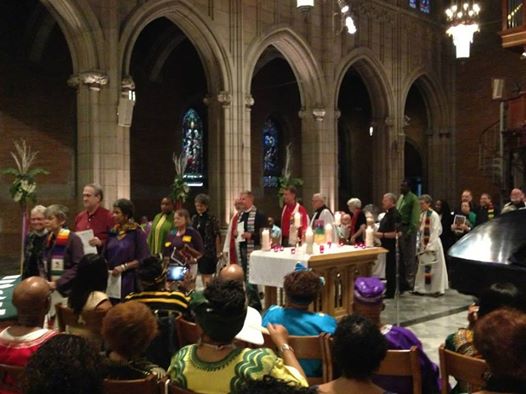
10561809_10204647229084675_6411741606349182744_nI had the privilege of being part of the procession of clergy at the Interfaith Worship for the Gay Games at Trinity Cathedral last Monday evening.  There were 4 of us from this congregation, but this is not about us.  We are not clergy who have been forced to hide who we are in order to do the work God has called us to do. That night we heard testimony from several who have. One voice came from my friend and colleague, Rev. Allen Harris, who serves as pastor at Franklin Circle10483169_10152537779999640_2675249037445610011_n Christian Church in Ohio City, spoke of a dark time in our own denomination’s recent history. In 1991, the election of the Rev. Dr. Michael Kinnamon to the position of General Minister and President was rejected because he refused to declare that homosexual acts were always sinful and that sexually active homosexuals should not be ordained. Kinnamon wrote: Disciples are not single issue people; we are gospel people. It is not the defense of homosexuality that we proclaim, but the primacy of grace, in light of which all of us are found wanting and through which alone all are bound in a community of forgiveness.  It brought tears to my eyes realizing that Allen, who is an openly gay man – and a fine pastor — continued to serve in a denomination that refused to recognize and accept who he was for all of those years.

I began to see more clearly than ever before that we are are witness to great faith in persons who are holding on. Holding on and accepting their call to be persuaders. Persuaders just like that Canaanite woman. Persuaders calling us to get ahead of ourselves and our prejudices and into the reality that all persons are God’s children.

The other reality we’re not ready for is being a country where our race does not determine our future.

I remember a conversation I had with a long-time member of our church who died a few years ago.  She was someone we’d call a pillar.  We were visiting one afternoon in her living room when the conversation turned to Barack Obama running for president. It was just weeks before the 2008 election. She wanted us to pray together that afternoon that our country would accept him and respect him as our first African American president. We prayed believing that our country was entering a new chapter in which the color of our skin would not keep us from being whoever we were called to be. Our hope kept us from seeing that more unaccepting and disrespectful chapters would be written before the one in which our country became post-racial.

We do not live in a post-racial America. It did not arrive in 2008, and we’re still looking for it in 2014. It is real that God loves all children equally. It is real that God demands justice and offers mercy to all, sadly there are still many in our country for whom that is getting ahead of ourselves.

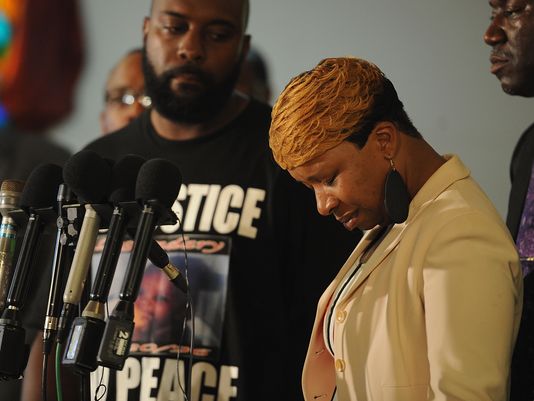
1407876745000-GTY-453497542-66427208It is impossible to be a pulpit this morning and ignore the tense situation in Ferguson, MO. One week later after the shooting of Michael Brown, we still do not know the details of how and why he was shot and killed.  Much is being disputed. What is not being disputed is he was shot multiple times, and he was unarmed. It is agonizing to see another mother whose child’s future was stopped by a bullet. In the work that David and I do in ending gun violence, we’ve had the privilege of meeting many mothers who have lost their children to gun violence.  We’ve heard them speak through their tears as activists who are determined this not to happen to another woman’s child. Lucy sybrinafultonluciamcbath1McBath, whose son Jordan Davis, unarmed, was shot and killed at a convenience store in Florida because someone thought he was playing his music too loud. Sabrina Fulton, mother of Trayvon Martin, unarmed and killed because he looked suspicious to a self-appointed neighborhood watchman. Dionna Perry, whose son, Brandon Young, unarmed, was gunned down here in Cleveland. We add Lesley McSpadden to that group of mothers.

DSC_6661ED1 copyThese mothers are determined that we will not ignore them. Making sure that we know this is real even if we don’t think we’re ready to know it.

So, I thank God for the persuaders. For that Canaanite woman who started it all by persuading Jesus to change his mind. To redirect his mission. To enlarge his concept of who deserved God’s mercy.  And I thank God for all those who have followed. I’ve named just a few. I know you can come up with other names. The people who demand to be treated as human beings. Fully human in the eyes of God. The people who insist that we listen before we’re ready to hear it. The people who persuade us to get ahead of ourselves.

multi-cultural-face-blog

Getting Ahead of Ourselves. It’s time.

Perhaps you’ve heard the statistic that our country will no longer have an ethnic majority by 2043. And even before that, in 2018 (only 4 years from now), our country will have no ethnic majority among those under 18 years of age. It’s time we get ahead of ourselves.

Jesus answered the challenge. Jesus had a change of heart and he changed his mind. Let’s follow him as we have promised.

Rev. Kristine Eggert

Pastor.  Parent.  Activist. 

Posted in Activism, Ending Gun Violence, God Before Guns, Good News, gun safety, LGBT, Loss of Child, Moms Demand Action, Multi-cultural, Racism, Uncategorized | Leave a comment

Two Miracles …

[from a sermon preached on Aigust 3, 2014]

There are many ways this morning feels like a summer morning, and one of them is that we are reading the story of the Feeding of the 5,000. It seems I preach on this story every summer. I suppose it comes up so often in the lectionary because it’s told in all four gospels. It’s the only miracle story that appears in all four – except for the resurrection. Each gospel tells the story a little differently – as you might expect in a reporting of what is going in in a crowd of 5,000.  How do people estimate the size of a crowd?  According to Matthew, the numbers were even bigger than that. 5,000 men plus women and children, and if you figure one woman per man, one child per family – that’s 15,000 and probably more.

So, here we go again with a story so familiar that you don’t even have to be a regular church goer listening to yet another sermon to know this story. Loaves and Fishes, as this story is known, is just a part of our language and culture – no big surprise given the number of hungry people in our world, and our humanitarian efforts to get food to people who are in need of it. That effort began in earnest for us during The Great Depression largely through the efforts of Dorothy Day who was co-founder of The Catholic Worker movement. She began as a journalist and then moved to be an activist in living as Jesus lived, serving as Jesus served. Feeding, housing, and clothing the urban poor. Teaching non-violence. When she wrote a book about it all, she titled it Loaves and Fishes. From that movement in the 1930’s to today, there have been and continue to be literally thousands of food pantries, community meals, and charitable organizations using the name.

Loaves and Fishes is such an often-told and well-worn story that it also brings some humor to therev joseph sidebotham table.  It’s not Holy Humor Sunday – that will be next year the Sunday after Easter. But just for a laugh today, here’s one …
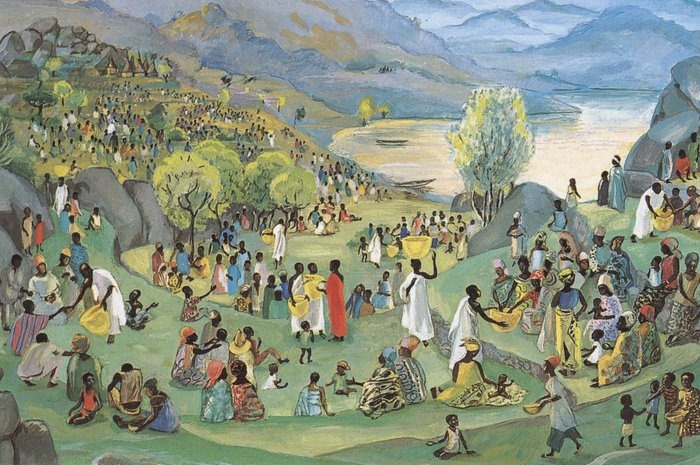
It helps to laugh doesn’t it? Especially when we are faced with something we really do not understand.

Like a miracle. We do not understand what happened that day – because a miracle by its very definition is not explainable. We’re not capable of understanding it exactly. I also believe it’s not up to us to parse and explain it away. We try to do that sometimes. It’s been in-vogue for several years now to explain this miracle by saying that: there were enough people in the crowd who’d brought food with them, that when they heard Jesus preaching, they were moved to share what they had. And that’s how there was enough for all of them. There’s always enough if we share is the message. Not a bad message, and I’m not disputing that Preacher Jesus would certainly have been capable of changing people’s behavior just by his words, but I’m going to stick with calling this a miracle.

I want to say that there was not just one miracle that day. There were two.

The feeding of the 5,000 was the 2nd. The first one slips right past us. Did you notice when I read that we started in the middle of something? It begins:  Now when Jesus heard this. What was this? What was it Jesus heard?

This was the death of John the Baptist. Jesus’ best friend.  A relationship that was beyond special. Their families were close. Their mothers spent their months of pregnancy together. They were both servants of God sent to preach the Good News. John baptized Jesus.

And John’s death was not by natural causes. He was murdered in a senseless act, and the details were horrific. Jesus wasn’t there for his friend. He’d only heard about it from John’s disciples. Have you experienced someone close to you dying and you weren’t there? Shocked and heartbroken, Jesus takes off to be by himself. We read: Jesus went off to a deserted place. Other translations equally accurate say: Jesus went by himself to a lonely place.

imagesI like that translation better because I’ve been to that lonely place. And so have you. We can be in a lonely place that is not deserted. It can be a room filled with people. If only we had looked up, we might have seen each other. In that lonely place. Sometimes we’re there because a loved one died. Or a friend betrayed us. A husband walked out. We lost a job. Took our health for granted until the shocking diagnosis. Our own thoughtless actions can take us there when we’ve inflicted hurt on someone else. The news of the world can take us there – either because we’re afraid or we feel powerless to do anything about it. All of that can take us to a lonely place.

The good news is – and there is good news. Jesus has already been there. And if we were to look up, we might see him there. Still. Waiting for us. Understanding what brought us there. Hurting as we hurt. Crying tears as real as the ones that we’re trying to hide.  Jesus is there making the lonely place not quite so lonely.

Jesus heard the news of his friend, and it affected him. Deeply. The more I think about that, the more connected I feel to him. The closer I feel to God. That brings me comfort, and I hope you feel that too. But there is even more good news. Jesus didn’t stay there. In that lonely place.

And that’s the first miracle. When a tired, exhausted, frightened, sad and disheartened man whoDomingo-XVIII-del-Tiempo-Ordinario-Ciclo-A-6 could very easily have been too tired to care, to self-absorbed to see, and too paralyzed to act – was awakened by his compassion for others. We see clearly that his compassion fed the 5,000. Can we also see that his compassion saved his life?  Compassion was his self-preservation.  Able to see beyond his own pain. Feeling the hurt of others. Pieces of him breaking apart, and still healing the brokenness of others. Starving in grief while also reaching out to feed someone else.

Jesus is our model and guide, and mentor who teaches us: Life is not about the disappointments we’ve faced. Life is in the possibilities in moving beyond them. Life is not about the grief we suffer. Life happens moving through that grief. Life is not the sum total of our defeats. Life is how we respond in the face of defeat. He is our savior who saves us by his compassion, and we are here to be his compassionate body.

And one more statement about what life is. Life is not in the secrets we keep. Life is in our openness to each other.

That’s from a book a church friend recommended to me recently. She’d found it helpful during some recent struggles of her own, and thought it might be helpful to me as I continue to work through the grief of my son’s death. It’s titled Broken Open: How Difficult Times Can Help us Grow. One of the essays is about the secrets we keep. Titled Open Secret which sounds like an oxymoron.   It’s a title taken from 13th century poet and mystic, Rumi who says that each of us is trying to hide something. To keep it secret from everyone else. In order to do that, we hole up in lonely places trying to keep people from knowing. We work so hard to keep people from knowing what we think is unique to us, that we fail to see what is universal to all of humankind. In today’s vernacular:  Everybody’s got something!  And yet in our everyday interactions when asked: Hi, how are you. We answer: Fine. The kids? Great.  How’s the job?  Love it.   How’s your health? Never felt better. None of which may be an accurate representation of what is really going on. We don’t want to say that one of our kids is failing in school or has a problem with drugs. We don’t want to admit that we just lost a job. Or, we were cheated on. And the biopsy brought devastating news.  So maybe we don’t know the other person well enough to bleed all over them. But more often, we mistakenly believe that the other person has his or her life all together.

Trust me. They do not. Have it all together. Trust me. They can understand all too well. Poet Rumi says this:

Learn the alchemy true human beings know. The moment you accept what troubles you’ve been given, the door will open.

I would change only one word. Rather than alchemy, I’d call it miracle. Learn the miracle true human beings know. And I’d write the next verse in the poem – to add, right after: the door will open, ….. and you will find the place where you can be the miracle for someone else.

We can be a miracle, just like Jesus was to the 5,000.

two miraclesOne disclaimer before I close. We have not yet achieved being just like Jesus. There is that potential, but we will not achieve it in our lifetimes. There will be moments when we come close, and in a life devoted to following him, those moments can become more closely spaced together. More frequent. So, please hear me when I say: I’m not suggesting that when we suffer a loss, when someone close to us dies, when the chemo isn’t working, when the foreclosure papers arrive, … that we ought to expect ourselves to be at the ready immediately to help someone else. We will not be as quick to respond as Jesus was that day. We should expect to visit the lonely place. If that has not happened yet, it will. You will find yourself there.

You will not be alone. Jesus was there – the seat is still warm – because his Spirit is there waiting for you. And if we could learn to be more open with our secrets and learn that it’s OK to acknowledge our pain to each other, that place would become much less lonely.

That’s a miracle in itself.  I guess that’s at least 3 for today. And there’s even more where those came from.

Let us pray:
Thank you, Jesus, for the miracles we see every day. Help me, Lord, to be a miracle for someone else. Amen.

Pastor Kris

Posted in Christian, Good News, Gospel, Grief, Loss of Child, Uncategorized | Leave a comment